Posts

Rainfall reduction of SW Australia

Image
A news story was published in mid 2017, the headline was " State and Federal Governments in talks over drought relief for WA farmers "  The story detailed the drought conditions being experience in parts of the WA wheatbelt region (historically Australia's most reliable wheat growing region). I wanted to briefly explore this story some more. The majority of the rainfall in SW Western Australia occurs during the winter months of June, July and August, with much less through the summer months. The winter rainfall through Western Australia has decreased by 20%  since 1960. This reduction in rainfall has led to a 40% drop in level of influx of rainfall into dams. Figure 1 shows the measured reduction in rainfall from the period of 1925 - 1975 to 1975 - 2003, in Southwest WA. Figure 1. Measured monthly rainfall for southwest WA for before and after 1975.  The mechanisms which have resulted in this decrease in rainfall are multi-faceted, including; land use change ,...

We're going through changes - El Nino the Southern Oscillation

Image
Variability of  ENSO  As I introduced in my most recent post, ENSO is a hugely important driver of climate across not only Australia, but the Pacific region and the wider world. Through the later part of the 20 th century and into the 21 st century, the nature of ENSO has changed , although there has always been variability between ENSO events, the goal posts have now moved and we’re playing in a different game. ENSO is not one beast, but is made of different flavours , which have been increasing distinguished from one another, whilst increasing in amplitude , with a change in system, comes a change in broad teleconnections, so the way in which people prepare and adapt to ENSO must also change.  T he largest change in ENSO, is demonstrated by the shift in the focal point of the sea surface temperature (SST)  anomaly  in the equatorial Pacific. Traditionally  the SST anomaly was focused in the Eastern Pacific (EP) and spread across the equato...

El Nino in Australia

Image
As an introduction to what will become a reoccurring theme over the next few weeks, I will use this post to familiarize the El Nino Southern Oscillation, commonly shortened to ENSO. ENSO is a non-linear climate phenomena and one of the primary drivers of  multi-year variability in world climate, through this, it is one of the largest influences on Australia's weather patterns.  The following video, from the  Australian Bureau Of Meteorology  covers the broad concepts of ENSO.   Video from Australian Bureau Of Meteorology  Over the next few weeks, I'll be exploring how ENSO impacts Australia and how these are predicted to change with anthropogenic climate change.

Beating around the bush

Image
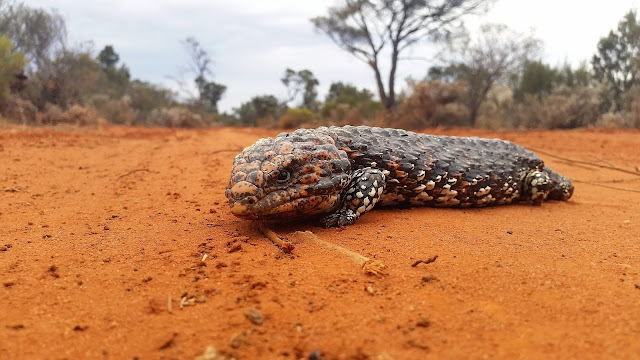
For this post, I wanted to introduce the biodiversity of Australia and look at how this is changing. Biodiversity is the variability of life and genetic health within an ecosystem, biodiversity is highest in areas of high primary productivity, such as tropical rain-forests and coral reef systems. Globally the genetic biodiversity of the world is classed as  beyond the zone of uncertainty , meaning we are in venturing in unknown waters, possibly creeping into a 6th a mass extinction .  Continental isolation has led to very high levels of endemism across the Australia continent and the surrounding ocean. Across the vast country, it's estimated still 75% of the flora and fauna remains to be formally described. There are 150,000 species of flora and fauna identified across Australia,  endemism is 93% through flowering plants, 46% of birds, 69% of mammals, 94% of amphibians, 93% of reptiles. Figure 1 shows an example of an endemic Australian reptile,   Tiliqua rugosa...

Satire in the name of love

Image
Social media is increasingly being used as a platform for communication, advertising and international diplomacy, as well as for smatterings of environmental satire, the latter is by far my favourite. To borrow a line from Peter Ustinov    "Comedy is simply a funny way of being serious”. A video from The Juice Media , in support of a Greenpeace campaign to keep Oil exploration out of the Great Australian Bight , captured some of the best aspects of comedy, whilst being informative, albeit with an array of profane language, as is the Australian way (viewer discretion is advised – profane language throughout). I’d like to touch upon and explore a couple of the talking points from the above video. Firstly, the assertion that the Great Barrier Reef is dead, this is not strictly true. Although the great barrier reef is not yet dead, coral bleaching events have progressively increased in severity across the great barrier reef from 1998, 2002 and 2016. During the mass bl...

Some like it even hotter

Image
This blog, ‘Australia and Climate Change’ is an avenue for me to explore and share how anthropogenic climate change is affecting the many different aspects and environments, of my adopted country of Australia. This first post will serve as a broad introduction to both the topic and myself.  I am a self-confessed environmentalist, but my background is as an exploration and mining geologist, from this, I will attempt to approach an array of topics pragmatically, covering a different issue with each post, whilst remaining the ability to cover up to the minute issues, as they occur. Australia covers 7.69 million km ­­2 of land surface, spanning equatorial, tropical, sub-tropical, desert, Grassland and temperate regions, in a hugely diverse country. These 6 large climate belts are subdivided by the Australian Bureau of Meteorology  (Fig. 1). The main drivers of climate through Australia are El NiƱo-Southern Oscillation (ENSO), the Indian Ocean Dipole, the Australian monsoon and...